 M.H. Material Handling costruisce un flusso continuo tra fasi produttive diverse, adattando ogni soluzione al punto preciso della linea in cui dovrà lavorare
In una linea per pet food umido il prodotto attraversa fasi molto diverse tra loro: dosaggio e confezionamento primario, chiusura, trattamento termico, raffreddamento, lavaggio, asciugatura, confezionamento secondario e fine linea. Cambiano le condizioni di processo, cambiano i requisiti igienici e, di conseguenza, deve cambiare anche il modo in cui il prodotto viene movimentato.
Nelle aree in cui il prodotto è ancora esposto al rischio di contaminazione, si richiedono standard più elevati, il sistema di trasporto deve essere progettato pensando alla pulizia già in fase costruttiva. Non basta utilizzare acciaio inox: occorre eliminare superfici orizzontali e punti di ristagno, rendere accessibili le parti da lavare e semplificare le operazioni di sanificazione.
È in queste zone che trovano applicazione le soluzioni della famiglia Sani-Line di M.H. Material Handling. Sani-Flex, per esempio, utilizza una struttura aperta in AISI 304, senza tubi cavi né superfici piane accoppiate, con saldature continue e catena sollevabile manualmente durante la pulizia. Quando l’applicazione richiede un nastro a tappeto, Sani-Belt porta gli stessi principi di accessibilità e facilità di lavaggio su una diversa superficie di trasporto. Anche i cambi di quota possono essere affrontati con soluzioni dedicate come Sani-Lift, mantenendo l’impostazione igienica della tratta.
Quando la confezione viene chiusa e il prodotto prosegue verso il trattamento termico, le esigenze della linea iniziano a cambiare. Nelle produzioni di pet food umido a lunga conservazione, lattine, vaschette o buste possono essere sottoposte a sterilizzazione. A monte e a valle di questa fase, la movimentazione deve alimentare il processo in modo regolare e gestire il passaggio verso raffreddamento, lavaggio e asciugatura, spesso in ambienti dove acqua e detergenti fanno parte della normale operatività.
Il punto più interessante è proprio il passaggio tra aree con requisiti diversi. Non esiste una configurazione unica da replicare lungo tutta la linea: una tratta progettata secondo criteri di massima sanificabilità può lasciare spazio, quando il prodotto è ormai sigillato e il rischio lo consente, a nastri lavabili in acciaio inox e successivamente a sistemi standard per il confezionamento secondario. M.H. adatta struttura, materiali, componenti e geometria del trasportatore alla zona in cui dovrà essere installato e alle procedure di pulizia previste dal cliente.
Anche l’accumulo deve seguire la stessa logica. Inserire un polmone tra due processi permette di assorbire microfermate o differenze temporanee di cadenza senza arrestare immediatamente l’intera linea, ma la macchina deve essere compatibile con l’ambiente in cui opera. Per questo il BAT Buffer, sistema di accumulo LIFO senza pressione, può essere realizzato anche con struttura in AISI 304 e configurato in versione lavabile. Nelle applicazioni che lo richiedono, accorgimenti specifici come grondaie di scolo tra i livelli evitano che acqua o residui provenienti dalle parti superiori ricadano sui prodotti sottostanti.
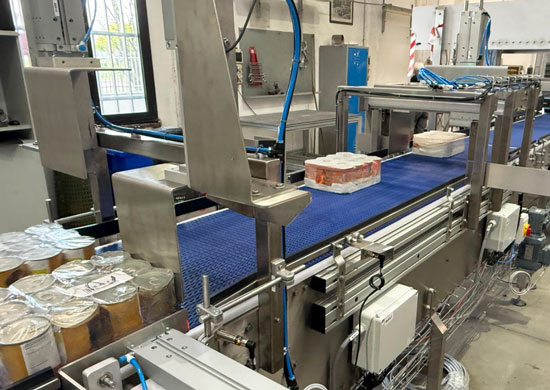 Procedendo verso il confezionamento secondario e il fine linea, le priorità cambiano ancora. Il prodotto è ormai protetto dalla confezione e diventano centrali la continuità del flusso, l’accumulo, l’unificazione delle file, lo smistamento, i cambi di quota e l’alimentazione regolare delle macchine a valle. Qui possono entrare in gioco trasportatori modulari, unificatori, smistatori ed elevatori, scelti e dimensionati in funzione della disposizione dell’impianto e della cadenza richiesta.
La progettazione di una linea pet food, quindi, non consiste nel collegare una serie di macchine con lo stesso tipo di nastro trasportatore. Significa leggere il processo per zone, capire come cambiano igiene, lavabilità e funzione della movimentazione e progettare ogni collegamento di conseguenza.
È questo l’approccio di M.H. Material Handling: costruire un flusso continuo tra fasi produttive diverse, adattando ogni soluzione al punto preciso della linea in cui dovrà lavorare. Perché il prodotto non deve soltanto arrivare a destinazione: deve attraversare correttamente tutto ciò che viene prima.
From packaging to end-of-line: The journey of pet food products
M.H. Material Handling creates a continuous flow between different production stages while adapting each solution to the exact point of the line where it will operate
In a wet pet food line, products move through very different processing stages: dosing and primary packaging, sealing, heat treatment, cooling, washing, drying, secondary packaging and end-of-line operations. Process conditions change, hygiene requirements change and, as a result, the way products are handled must change as well.
In areas where the product is still exposed or where contamination risks require higher hygiene standards, the conveying system must be designed with cleaning in mind from the very beginning. Using stainless steel alone is not enough: horizontal surfaces and potential stagnation points must be reduced, the parts requiring cleaning must remain easily accessible, and sanitation procedures should be made as simple as possible.
This is where M.H. Material Handling’s Sani-Line solutions come into play. Sani-Flex, for example, features an open AISI 304 stainless-steel structure, with no hollow sections or overlapping flat surfaces, continuous welds and a modular chain that can be lifted manually during cleaning. When the application requires a belt conveyor, Sani-Belt applies the same principles of accessibility and ease of cleaning to a different conveying surface. Height changes can also be handled with dedicated solutions such as Sani-Lift, while maintaining the hygienic design of the conveying section.
Once the package has been sealed and the product moves towards heat treatment, the requirements of the line begin to change. In the production of shelf-stable wet pet food, cans, trays or pouches may undergo sterilization. Upstream and downstream of this stage, the handling system must feed the process consistently and manage the transition towards cooling, washing and drying, often in environments where water and detergents are part of normal operating conditions.
One of the most interesting aspects is precisely the transition between areas with different requirements. There is no single configuration that can simply be replicated throughout the entire line: a section designed according to highly hygienic principles may give way, once the product is fully sealed and the risk level allows it, to washable stainless-steel conveyors and later to standard systems for secondary packaging. M.H. adapts the conveyor structure, materials, components and geometry to the area where it will be installed and to the cleaning procedures specified by the customer.
Accumulation must follow the same logic. Installing a buffer between two processes can absorb short stops or temporary differences in production rate without immediately bringing the entire line to a halt, but the machine itself must be compatible with the environment in which it operates. For this reason, the BAT Buffer, a pressureless LIFO accumulation system, can also be manufactured with an AISI 304 stainless-steel structure and configured in a washable version. Where required by the application, specific features such as drainage gutters between levels prevent water or residues from the upper sections from dripping onto the products below.
Moving towards secondary packaging and end-of-line operations, priorities change once again. The product is now protected by its packaging, and flow continuity, accumulation, lane merging, sorting, height changes and the consistent feeding of downstream machines become increasingly important. Modular conveyors, unifiers, sorters and elevators can all come into play at this stage, selected and sized according to the plant layout and the required production rate.
Designing a pet food line, therefore, does not simply mean connecting a series of machines with the same type of conveyor. It means looking at the process area by area, understanding how hygiene, washability and the role of product handling change along the way, and designing each connection accordingly.
This is the approach of M.H. Material Handling: creating a continuous flow between different production stages while adapting each solution to the exact point of the line where it will operate. Because the product does not simply need to reach its destination: it needs to move correctly through everything that comes before it.